Sega パソコン学習机 (PC Study Desk): Difference between revisions
Created page with "{{Infobox cabinet |name = セガパソコン学習机 |kana = セガパソコン学習机 |romaji = PASOKONGAKUSHŪTSUKUE |aka = PC Study Desk, Game Learning Desk, PC Learning Desk |image = Sega pc study desk thumbnail pic.png |type = Sitdown |year = 1983 |depth = 900 |width = 890 |height = 1200 (1240 with header) |wiring = modified SEGA SC-3000 personal computer system |monitor_size = 18 |monitor_sync = |monitor_lcdres = |monitor_model = |rotatable = no |rotate_mech..." |
mNo edit summary |
||
| Line 1: | Line 1: | ||
{{Infobox cabinet | {{Infobox cabinet | ||
|name = | |name = パソコン学習机 | ||
|kana = | |kana = パソコン学習机 | ||
|romaji = PASOKONGAKUSHŪTSUKUE | |romaji = PASOKONGAKUSHŪTSUKUE | ||
|aka = PC Study Desk, Game Learning Desk, PC Learning Desk | |aka = PC Study Desk, Game Learning Desk, PC Learning Desk | ||
Latest revision as of 06:38, 26 March 2026
| パソコン学習机 | |
|---|---|
 | |
| Katakana | パソコン学習机 |
| Rōmaji | PASOKONGAKUSHŪTSUKUE |
| AKA | PC Study Desk, Game Learning Desk, PC Learning Desk |
| Type | Sitdown |
| Released | 1983 |
| Dimensions | 900 x 890 x 1200 (1240 with header) mm |
| Wiring | modified SEGA SC-3000 personal computer system |
| Monitor | 18 in |
| Rotatable | no |
| Power Supply | AC 100 V |
| Power | 150 W |
SEGA released in 1983, shortly after their SC-3000 Personal Computer, the hybrid arcade/learning "desk" called セガパソコン学習机 (PASOKONGAKUSHŪTSUKUE translated as PC Study Desk or rarely Game Learning Desk or PC Learning Desk), exclusive to Japan.
It featured the SC-3000's own keyboard as well as a single or 2 player control panel with joystick(s) and a set of 2 arcade buttons per player. The unit was distributed by Esco Trading company for SEGA Enterprises.
The hybrid concept was based on "learning while having fun" according To SEGA. Promo material stated the user could pay for a time-based play/learning session which could be adjusted individually for each game or educational software, which could be chosen amongst 10 (each software assigned to a dedicated square button next to the monitor with its own mini marquee), at the time of launch, late 1983 early 1984 there were 30-35 total games and programs available for the system, adverts and flyers explained the PC Study Desk was meant specifically to learn music (via composing, arrangements, reading), math (geometry, calculus), foreign languages (English...), chemistry and above all programming in BASIC.
Several optional modules were available for the PC Study Desk such as the SR-1000 Data Recorder and the SP-400 Printer.
Launch price was ¥280,000 for the main unit with one BASIC progamming software.
Almost two years later circa 1985, SEGA had Coreland revisit the concept with the Soft Desk 10 (& MkIII variant), keeping the 10 game per cabinet idea but dropping the SC-3000 Personal Computer along its educational aspect , focusing solely on games and adopting a "mini-upright" (sitdown) dagashiya style cabinet design to clear any past confusion, yet keeping the "Desk" moniker. The Soft Desk 10 cabs would then house a SG-1000 and later a Mark III console systems.
- Some published adverts mixed up SC- and SG- systems from SEGA claiming for example that the PC Study Desk was housing a "SG-3000" while it had in reality a SC-3000 Personal Computer as explained above, "SG-" being the code for the console equivalent (SG-1000) seen later in the Coreland Soft Desk 10 cabinets.
Gallery
-
 Flyer
Flyer -
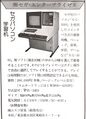 advert (erroneous mention of SG-3000 when it is truly a SC-3000 system inside)
 -


.jpg)
.jpg)