Namco Consolette 18: Difference between revisions
→Gallery: Displaced 4 pics from Consolette 26 wiki article for the simple reason that the cabs are Consolette 18; + pic tags by original editor now publicly visible |
initial introduction was 1987 for consolette 18 not 1989 (1989= commercial launch of consolette 26). added cab geometry & stacking info |
||
| Line 6: | Line 6: | ||
|image = Consolette 18.jpg | |image = Consolette 18.jpg | ||
|type = Sitdown | |type = Sitdown | ||
|year = | |year = 1987 | ||
|depth = 732 | |depth = 732 | ||
|width = 580 | |width = 580 | ||
| Line 20: | Line 20: | ||
|power = 91 | |power = 91 | ||
}} | }} | ||
'''NAMCO''' launched their '''''Consolette 18''''' cabinet in 1987, most probably in response to SEGA's 1986 [[City]]. | |||
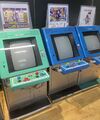
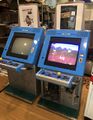
With the ''Consolette 18'', NAMCO introduced a yet unseen design novelty by having the control panel box secured firmly at a small distance from the main chassis via two lateral curved steel tubular "arms", which would internally route the wire harness connecting the joysticks and buttons. | |||
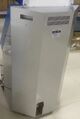
NAMCO intentionally heavily slanted the corners of the back portion of the cabinet in order to have a unit easily secured in a room corner to save precious space, or have several aligned in a row at an angle against a wall, as well as to be able to stack several Consolette 18 cabs astutely as if they were octogons with published promo material (see below in ''Gallery'') showing clusters of 2 up to 6 cabs joined via corner faces and or back to back & laterally, sometimes using as much as two spacers between each cab. | |||
==Gallery== | ==Gallery== | ||
<gallery> | <gallery> | ||
Image:Flyer Consolette 18 front.jpg| | Image:Flyer Consolette 18 front.jpg| | ||
Image:Flyer Consolette 18 back.jpg| | Image:Flyer Consolette 18 back.jpg|Cabinet stacking options in clusters of 2, 4 and 6 cabs in different configurations (via corner faces, back to back & laterally) eventually with up to 2 spacers. Fitting of a single cabinet in a corner and row of cabinets againts a wall also shown. | ||
Image:Namco consolette 18 tate green & blue.jpg | Image:Namco consolette 18 tate green & blue.jpg | ||
Image:Namco consolette 18 blue.jpg | Image:Namco consolette 18 blue.jpg | ||
| Line 29: | Line 35: | ||
image:Consolette 18 jp flyer.jpg | image:Consolette 18 jp flyer.jpg | ||
Image:Namco consolette 18 label.jpg | Image:Namco consolette 18 label.jpg | ||
Image:Namco Consolette and Capcom Minicute price.jpg| | Image:Namco Consolette and Capcom Minicute price.jpg|Launch price advertisement | ||
Image:Consolette setup.jpg|Prabo & Pretz Nishizawa Minami Matsumoto shop (Matsumoto City, Nagano Prefecture: about june 1989). | Image:Consolette setup.jpg|Prabo & Pretz Nishizawa Minami Matsumoto shop (Matsumoto City, Nagano Prefecture: about june 1989). | ||
Image:Consolette setup 2.jpg|Consolette setup 2 | Image:Consolette setup 2.jpg|Consolette 18 setup 2 | ||
Image:Play City Carrot Consolette.jpg|Play City Carrot (Shinagawa-ku, Tokyo: about december 1988) 8 minute walk from JR Gotanda stop | Image:Play City Carrot Consolette.jpg|Play City Carrot (Shinagawa-ku, Tokyo: about december 1988) 8 minute walk from JR Gotanda stop | ||
</gallery> | </gallery> | ||
Revision as of 08:26, 11 June 2026
| Namco Consolette 18 | |
|---|---|
 | |
| Katakana | コンソレット |
| Type | Sitdown |
| Released | 1987 |
| Dimensions | 732 x 580 x (1079, 1430 including marquee) mm |
| Wiring | JAMMA |
| Monitor | 18 in 15/24 kHz |
| Rotatable | Yes |
| Weight | 60 kg |
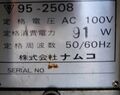
| Power Supply | AC 100V |
| Power | 91 W |
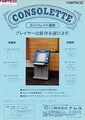
NAMCO launched their Consolette 18 cabinet in 1987, most probably in response to SEGA's 1986 City.
With the Consolette 18, NAMCO introduced a yet unseen design novelty by having the control panel box secured firmly at a small distance from the main chassis via two lateral curved steel tubular "arms", which would internally route the wire harness connecting the joysticks and buttons.
NAMCO intentionally heavily slanted the corners of the back portion of the cabinet in order to have a unit easily secured in a room corner to save precious space, or have several aligned in a row at an angle against a wall, as well as to be able to stack several Consolette 18 cabs astutely as if they were octogons with published promo material (see below in Gallery) showing clusters of 2 up to 6 cabs joined via corner faces and or back to back & laterally, sometimes using as much as two spacers between each cab.
Gallery
-

-
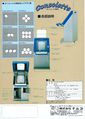 Cabinet stacking options in clusters of 2, 4 and 6 cabs in different configurations (via corner faces, back to back & laterally) eventually with up to 2 spacers. Fitting of a single cabinet in a corner and row of cabinets againts a wall also shown.
 -
-
-
-
-
-
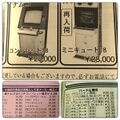 Launch price advertisement
 -
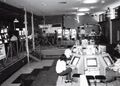 Prabo & Pretz Nishizawa Minami Matsumoto shop (Matsumoto City, Nagano Prefecture: about june 1989).
 -
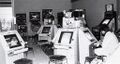 Consolette 18 setup 2
 -
 Play City Carrot (Shinagawa-ku, Tokyo: about december 1988) 8 minute walk from JR Gotanda stop


