Capcom Mini Cute
| Capcom Mini Cute | |
|---|---|
 | |
| Katakana | キュート |
| Rōmaji | KYŪTO |
| AKA | Capcom Cute; Cute; Minicute |
| Type | Sitdown |
| Released | 1991 |
| Dimensions | 690 x 500 x 1300 mm |
| Wiring | JAMMA |
| Monitor | 18 in 15 (commonly reported) kHz (Sanwa 18V21CP-2; PM1723E chassis commonly reported; Nanao MS8-18 also reported but factory status unverified) |
| Rotatable | Yes |
| Weight | 60 kg |
| Power Supply | Switching regulator (+5V 10A, +12V 3A, -5V 1A, -12V 1A) |
| Power | 95 W |
The Capcom Mini Cute (キュート, Kyūto), also known as the Capcom Cute, is an 18-inch compact sitdown arcade cabinet manufactured by Capcom.
An original Capcom sales flyer is marked © CAPCOM 1991, establishing that the cabinet was being advertised by 1991, although the exact introduction date has not been independently confirmed.[1]
Capcom promoted the cabinet as a new, compact style of game cabinet intended to occupy less floor space than conventional Japanese arcade machines. It measures 1300 mm high, 500 mm wide and 690 mm deep, and weighs approximately 60 kg.[2]
The cabinet uses JAMMA wiring and was supplied with an 18-inch CRT monitor. The original instruction manual's wiring diagram identifies the monitor as a Sanwa 18V21CP-2.[2]
The monitor can be changed between horizontal and vertical orientation. The cabinet does not contain a dedicated rotation mechanism: four mounting flange nuts must be removed before the monitor is manually rotated, and the removable monitor surround must also be turned to match the new orientation.[2]
Design
The Mini Cute was designed around a footprint of only 500 × 690 mm. Capcom promoted the narrow cabinet as allowing operators to make more efficient use of limited floor space.[3]
The flyer also advertised the cabinet as a piece of movable interior furniture whose compact shape allowed several machines to be arranged in different layouts.[3]
Casters fitted beneath the cabinet allow it to be moved. Two adjustable feet are used to secure and level the cabinet after it has been positioned.[2]
A transparent instruction panel extends from the top of the cabinet. The manual identifies this as a two-part assembly consisting of:
- Panel A, made from coloured corrugated plastic
- Panel B, made from transparent acrylic
Printed instructions or promotional material can be held between the two panels.[2]
Security and service access
The Mini Cute uses a nested two-door arrangement promoted by Capcom as both a security feature and a means of simplifying routine maintenance.[3]
Opening the large outer front door provides access to the monitor, game PCB, coin selector and routine service controls. A separately locked inner door protects the coin box, coin counter and other internal equipment.[2]
The monitor and twin speakers are mounted in the upper portion of the hinged outer door.
The game PCB is attached to a removable mounting base on the inside of the outer door. After disconnecting the JAMMA connector and releasing two wing screws, the board and its mounting base can be removed through the front of the cabinet.[2]
The manual identifies the following internal service controls:
- Service switch
- Test switch
- Sound-volume control
- Coin counter
- Adjustable +5 V output control
An AC switch, fuse, earth connection and service outlet are located at the rear of the control-box area.[2]
Monitor
The original Capcom instruction manual and its wiring diagram identify the supplied monitor as a Sanwa 18V21CP-2.[2]
The designation PM1723E is commonly associated with the original monitor chassis in collector references, but this designation is not printed in the available Capcom manual.[4]
A Nanao MS8-18 has also previously been listed as an alternative monitor for the cabinet. No Capcom document examined for this article identifies the Nanao monitor, so it is presently unclear whether it was a factory production variation or a later replacement.
The cabinet is generally documented as using a 15 kHz standard-resolution display.[4] The available instruction manual does not explicitly print the horizontal scan frequency, so this specification is retained from established cabinet references rather than treated as independently confirmed by the manual.
The CRT has previously been described as a 47 cm tube. This may refer to the outside measurement of the tube rather than the nominal viewable screen size, but the 47 cm measurement has not been confirmed in the available Capcom manual or flyer. Capcom's own documentation describes the display as an 18-inch monitor.
The monitor can be installed in either horizontal or vertical orientation. Changing its orientation requires the outer door to be opened and four mounting flange nuts to be removed. The monitor is then manually rotated and refitted. There is no built-in rotation mechanism.[2]
The CRT surround, described in the manual as the escutcheon, is clipped into the inside of the front door and must be removed and rotated separately.[2]
The monitor adjustment panel provides controls for:
- Red gain
- Green gain
- Blue gain
- Brightness
- Horizontal position
- Horizontal size
- Horizontal hold
- Vertical position
- Vertical size
- Vertical hold
- Horizontal sub-position
- Vertical linearity
- Focus
The monitor wiring also provides connectors for reversing the deflection-yoke connection when changing the screen orientation.[2]
Controls and audio
The original promotional material and instruction manual show a two-player control panel with one joystick and three action buttons for each player.
The control panel is housed in a hinged control box, allowing the controls and coin-entry guide to be reached for servicing.
The coin denomination can be changed by replacing the coin selector and adjusting the coin-entry guide.[2]
The cabinet has two speakers mounted above the monitor. A sound-volume control is accessible after opening the front door.[2]
Coin mechanism
The coin selector is mounted inside the outer front door. It can be removed by releasing its retaining stopper.[2]
The manual also describes provision for an optional coin blocker assembly, model 9L-102. The coin blocker was sold separately and mounts to the selector's channel bracket.[2]
Coins are collected in a locked coin box behind the separately secured inner door. A coin counter is also located behind this inner security door.[2]
Dimensions
| Height | 1300 mm |
|---|---|
| Width | 500 mm |
| Depth | 690 mm |
| Weight | 60 kg |
| Monitor | 18 inch |
Electrical specifications
| Input voltage | AC 100–120 V, 50/60 Hz |
|---|---|
| Power consumption | 95 W |
| Wiring | JAMMA |
| Documented monitor | Sanwa 18V21CP-2 |
| Commonly reported chassis | PM1723E |
| Reported alternative monitor | Nanao MS8-18 — factory status unverified |
| Commonly reported monitor frequency | 15 kHz |
| +5 V output | 10 A |
| +12 V output | 3 A |
| −5 V output | 1 A |
| −12 V output | 1 A |
The power supply's +5 V output can be adjusted from inside the lower cabinet compartment.[2]
Construction and features
- Compact sitdown cabinet
- 18-inch colour CRT monitor
- Sanwa 18V21CP-2 monitor documented in the manual
- 15 kHz video, according to established cabinet references
- Horizontal or vertical monitor mounting
- Manual monitor rotation
- No dedicated monitor-rotation mechanism
- Removable and rotatable CRT surround
- JAMMA wiring
- Two-player control panel
- Three action buttons per player in the documented configuration
- Twin upper-mounted speakers
- Hinged full-height outer front door
- Separately locked inner security door
- Front-access game PCB mounting base
- Lockable coin box
- Coin counter
- Replaceable coin selector
- Provision for an optional coin blocker
- Service and test switches
- Internal sound-volume control
- Adjustable +5 V supply
- Service AC outlet
- Transparent instruction panel
- Moving casters
- Two adjustable levelling feet
Reproductions and clones
The scarcity and high market value of original Capcom Mini Cute cabinets has led to several modern reproductions and clone cabinets.
These reproductions are not all the same product and differ in construction, monitor hardware, internal layout, wiring, included components and control-panel configuration. None are known to have been manufactured, authorised or licensed by Capcom.
The main reproduction families currently documented are:
- TRFightstick Mini Cute Clone — an enthusiast reproduction project begun in 2018 by Hursit / TR Fight Stick. These cabinets were supplied without a monitor and were designed to accept a 19-inch CRT.
- Chinese Mini Cute Clone — generic Chinese reproductions sold through AliExpress, Alibaba and similar marketplaces. These are commonly supplied with an 18-inch CRT and chassis, although multiple OEMs or production revisions may exist.
- Vortex Arcade Mini Cute Clone — a later reproduction marketed by Vortex Arcade, supplied with an 18-inch CRT and revised internal hardware.
A broader comparison of the known reproduction types is available at Capcom Mini Cute Clones.
Because reproduction artwork can closely resemble the original Capcom graphics, cabinets offered for sale should be identified from their construction, monitor fittings, internal hardware and provenance rather than from decals alone.
TR Fight Stick reproduction
A fan-led reproduction project was begun in March 2018 by the Turkish arcade-hardware maker Hursit, associated with TR Fight Stick. The project was documented publicly on the Arcade-Projects forum.[5]
The stated aim was to reproduce the cabinet's metal construction and external appearance. Measurements and photographs were supplied by owners of original Capcom cabinets. The documented development process included computer drawings, prototype metal panels, control-panel fabrication, coin-box construction and completed prototype cabinets.[5]
A separate pre-order and production thread was opened in November 2019. The proposed initial shipment was organised around a batch of up to 40 cabinets transported in a 20-foot shipping container.[6]
The advertised United States base price was US$1,500 at the American distributor's warehouse, excluding onward domestic delivery. The forum user Cereth, also identified as Game_Saru, was named as the project's United States distributor.[6]
The advertised reproduction package included:
- Powder-coated metal cabinet components
- Wheels
- Plexiglass components
- JAMMA wiring
- Locks and keys
- Control-panel artwork
- Cabinet decals
- Marquee holder
- Monitor bezel intended for a 19-inch Wells-Gardner arcade monitor
The reproduction cabinets were offered in yellow, pink and green. These were described by the project's organiser as the three original colours, although this colour history has not been independently verified against a Capcom catalogue or manufacturing document.[6]
A monitor, joysticks, pushbuttons and coin mechanism were not included in the original pre-order specification. Buyers were expected to obtain and install these components themselves.[6]
The replica was designed to accept a 19-inch monitor, most notably a Wells-Gardner K7000-type CRT, rather than the original 18-inch Sanwa 18V21CP-2.
The Capcom-branded decals were not attached before the cabinets were transported. The organiser stated that the reproduction artwork would be shipped separately because of concerns surrounding the use of Capcom's trademarks.[6]
Completed cabinets had reached customers by August 2021. Recipient posts show owners fitting monitors, speakers, controls and wiring to the delivered cabinet shells.[7]
The available project documentation does not establish a final production total. The stated figure of 40 represented the proposed capacity of the initial container shipment and should not be treated as the confirmed number ultimately manufactured.
For full details, see TRFightstick Mini Cute Clone.
Chinese marketplace reproductions
Later Mini Cute reproductions have also been sold through Chinese online marketplaces including AliExpress and Alibaba.
These cabinets are commonly supplied with an approximately 18-inch CRT monitor and monitor chassis, unlike the earlier TR Fight Stick reproduction.
The available evidence does not establish that all marketplace examples originate from a single manufacturer. Differences between listings and surviving examples suggest that multiple production revisions or OEM manufacturers may exist.
No direct connection between these cabinets and the Hursit / TR Fight Stick project has been established.
For full details, see Chinese Mini Cute Clone.
Vortex Arcade reproduction
Vortex Arcade later marketed its own Mini Cute reproduction.
The Vortex version is supplied with an 18-inch CRT monitor and revised internal hardware and differs from both the earlier TR Fight Stick reproduction and generic Chinese marketplace cabinets.
Its monitor and chassis are mounted together in a removable frame, allowing the monitor to be manually changed between horizontal and vertical orientation.
For full details, including the documented monitor-rotation procedure, see Vortex Arcade Mini Cute Clone.
Gallery
Flyers
-
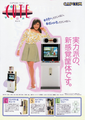 Advertising flyer
-
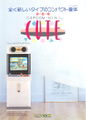 1991 Capcom Mini Cute flyer
-
 Specifications and features flyer
-
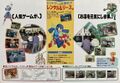 Capcom New Concept II and Mini Cute flyer
-
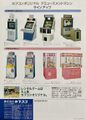 Capcom cabinet flyer


Cabinet and components
-
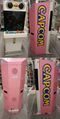 Cabinet from multiple sides
-
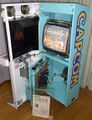 Cabinet opened for servicing
-
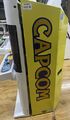 Colour variants
-
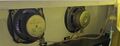 Original loudspeakers
-
 Loudspeaker frequency-response graph


Manuals and technical documentation
The instruction manual contains installation instructions, monitor-rotation procedures, game-board removal instructions, coin-selector information, monitor adjustments and complete cabinet wiring diagrams.
Artwork

See also
- Capcom Mini Cute Clones
- TRFightstick Mini Cute Clone
- Chinese Mini Cute Clone
- Vortex Arcade Mini Cute Clone
Notes
The original Capcom flyer is marked © CAPCOM 1991. This confirms that the cabinet was being advertised by 1991, but a copyright notice does not necessarily establish the exact introduction or first-production date.[1]
The specifications flyer carries the designation 95-4473. The flyer does not explain the meaning of this designation, and it should not be interpreted as a date without further documentation.[3]
The wiring diagram in the surviving instruction-manual scan carries a revision date of 23 October 1994. This appears to date the drawing or manual revision rather than the cabinet's original introduction.[2]
The available Capcom manual identifies the original monitor as a Sanwa 18V21CP-2. The commonly used PM1723E chassis designation is supported by collector documentation but is not printed in the available manual.
A Nanao MS8-18 has previously been listed as an alternative monitor. Its status as original factory equipment has not been verified.
The 15 kHz monitor frequency is consistently reported by cabinet references, but it is not explicitly printed in the available Capcom instruction manual.
The previously reported 47 cm tube measurement has not been confirmed in the available Capcom documentation.
External links
Information and documentation
- Hard*Candy – Capcom Cute
- Capcom Cute instruction manual
- Capcom Mini Cute restoration
- TR Fight Stick reproduction development thread
- TR Fight Stick reproduction pre-order and production thread
Reproduction artwork and parts
- Reproduction side art
- Reproduction speaker decal
- Reproduction coin-reject decal
- Reproduction control-panel overlay
- Reproduction control-panel overlay
- Reproduction warning-label set
- 3D-printable coin-slot plate
References
- ↑ 1.0 1.1 Capcom Mini Cute sales flyer, © 1991.
- ↑ 2.00 2.01 2.02 2.03 2.04 2.05 2.06 2.07 2.08 2.09 2.10 2.11 2.12 2.13 2.14 2.15 2.16 2.17 2.18 Capcom Cute instruction manual, pp. 1–9.
- ↑ 3.0 3.1 3.2 3.3 Capcom Mini Cute specifications and features flyer.
- ↑ 4.0 4.1 Hard*Candy – Cute cabinet profile.
- ↑ 5.0 5.1 Mini Cute Arcade Cabinet – reproduction development thread, Arcade-Projects, started 18 March 2018.
- ↑ 6.0 6.1 6.2 6.3 6.4 Pre-Order For Mini Cute Production, Arcade-Projects, started 12 November 2019.
- ↑ Pre-Order For Mini Cute Production, page 80, Arcade-Projects, August 2021.