DECO Cassette System
| DECO Cassette System | |
|---|---|
 | |
| Released | 1980 |
| Wiring | Proprietary DECO Cassette System |
The DECO Cassette System is an interchangeable arcade hardware platform developed by Data East around 1980.
Rather than supplying each game as a completely separate arcade PCB, Data East designed the system around a reusable cabinet and hardware platform. Individual games were supplied as game kits consisting primarily of a cassette tape, key module and game explanation panel.
The cabinet assembly itself was designed to remain in service while games were changed by exchanging these game-specific components.
Data East's original manuals explicitly describe the system as comprising two main elements:
- Cabinet assembly
- Game kit
and state that the cabinet assembly was designed to accept and display any game supplied as a compatible DECO game kit. :contentReference[oaicite:0]{index=0}
Concept
The DECO Cassette System was intended to reduce the cost of changing games in an arcade.
Instead of replacing the entire machine, operators could retain:
- Cabinet
- CRT monitor
- PCB rack
- Core system boards
- Power supply
- Cassette deck
- Coin equipment
and replace the game-specific components.
A standard game kit comprised:
- Cassette tape
- Key module
- Game explanation panel
Optional control panels were also available for titles which could not be operated using the standard controls. :contentReference[oaicite:1]{index=1}
Game loading
The cassette does not function like continuously accessed game media.
When the cabinet is switched on, the cassette tape runs and the game program is transferred into the system's working memory.
The operator then waits several minutes for the programming process to complete before play can begin.
The original installation instructions specify the following general procedure:
- Install the appropriate game explanation panel.
- Fit the matching key module.
- Set the game's DIP switches.
- Insert the cassette with the power switched off.
- Confirm that the boards and connectors are correctly seated.
- Switch on the cabinet.
- Wait while the game data is transferred into memory.
- Test the game using the service switch.
- Test normal coin operation.
Data East's table-cabinet manuals describe this process as taking a few minutes. :contentReference[oaicite:2]{index=2}
Game kit
A DECO game change normally requires the matching:
- Cassette tape
- Key module
- Instruction / explanation panel
For some games, the control panel must also be exchanged.
The key module forms part of the system's protection and game-identification arrangement and must correspond to the installed cassette.
The manuals specifically warn operators to switch the cabinet off before inserting or removing a cassette.
Hardware architecture
The DECO Cassette System uses a multi-board hardware architecture.
Different documented cabinet revisions use different versions of the core board set.
Early board set
The Data East DS-1T2, Data East DS-1T3 and Data East DS-1U2 manuals document an early hardware stack consisting of:
| Board | Data East part number | Designation |
|---|---|---|
| PCB 1 | ML-10107 | RMS3 |
| PCB 2 | ML-10106 | DSP3 |
| PCB 3 | ML-10108 | B103 |
| Motherboard | ML-10111 |
The DS-1T3 parts documentation also identifies the complete 14-inch monitor assembly as KZ-14EA-D. :contentReference[oaicite:3]{index=3}
Later board set
The later Data East DN-1US5 documents a revised DECO hardware stack using:
- RMS8
- DSP8
- B108
This shows that the DECO Cassette System existed in more than one hardware revision rather than using a single fixed PCB set throughout its life.
The later system still follows the same basic design philosophy: reusable hardware with game data loaded from cassette.
RMS board
The RMS board provides much of the system's memory and sound functionality.
Functions documented on later revisions include:
- Dynamic RAM
- Program memory
- Display memory
- Sound CPU
- Sound ROM/RAM
- Audio mixing
- DIP-switch reading
- Bootstrap ROM
- Communication with the main CPU
The later RMS8 documentation specifies approximately 48 Kbytes of dynamic memory.
DSP board
The DSP board handles much of the system's main video and display processing.
Documented functions include:
- Main CPU and timing circuitry
- Colour-signal generation
- Horizontal synchronisation
- Vertical synchronisation
- CRT timing
- Display control
- Graphics generation
- Sprite / object generation
- Mix-mode generation
The exact implementation differs between hardware revisions.
B-series I/O board
The B-series board handles much of the cabinet I/O.
On the later B108 revision, documented functions include:
- Control-panel inputs
- Coin-switch inputs
- Coin-counter outputs
- Coin-blocker outputs
- Service input
- Cassette-deck interface
- Back-display control
- Volume input
- Communication with the system CPU
Cassette deck
The cassette deck is mounted inside the cabinet and is treated as a replaceable service component.
At power-on, the deck reads the installed game cassette and transfers its data into memory.
Once loading is complete, normal game operation takes place from the system electronics and memory rather than by continuously reading the tape.
The cassette deck is therefore an installation and boot medium rather than a conventional continuously accessed storage device.
Key module
Each game uses a matching key module.
The key module is inserted into the PCB rack and must correspond to the cassette being used.
If the incorrect module is fitted, or the module connection is faulty, the game will fail to initialise correctly.
The key module is therefore an essential part of each DECO game kit.
Control panels
Data East designed the DECO Cassette System around interchangeable controls as well as interchangeable software.
The manuals show:
- Standard control panel
- Optional panel 1
- Optional panel 2
This allowed operators to install games requiring different control layouts without replacing the whole cabinet. :contentReference[oaicite:4]{index=4}
Cabinet range
Several dedicated DECO Cassette System cabinets are currently documented.
| Cabinet | Type | Monitor | Notes |
|---|---|---|---|
| Data East DS-1T2 | Cocktail | 14-inch | Early cassette-system table cabinet |
| Data East DS-1T3 | Cocktail | 14-inch | Closely related table revision |
| Data East DS-1U2 | Upright | 20-inch | Upright cassette-system cabinet |
| Data East DN-1US5 | Upright | 20-inch | Later/export upright hardware revision |
Data East also sold conversion equipment allowing existing arcade cabinets to be adapted for DECO Cassette System use.
DS-1T2
The DS-1T2 is a 14-inch cocktail cabinet built specifically around the DECO Cassette System.
It uses opposing player controls, adjustable-height legs and an internal cassette deck and PCB rack.
It was intended as a reusable multi-game platform rather than a title-specific cabinet.
DS-1T3
The DS-1T3 is another 14-inch cocktail/table cabinet in the same family.
Its documented specifications include:
- 860 × 560 mm footprint
- 600–800 mm adjustable height
- 55 kg weight
- 14-inch CRT
- Approx. 100 W consumption
The DS-1T3 manual uses the RMS3 / DSP3 / B103 board stack. :contentReference[oaicite:5]{index=5}
DS-1U2
The DS-1U2 is the upright counterpart to the table cabinets.
Its documented specifications include:
- 600 mm width
- 740 mm depth
- 1,680 mm height
- 82 kg weight
- 20-inch colour CRT
- Approx. 130 W consumption
- Approx. 3,000-coin cash-box capacity
The core system hardware remains closely related to the early table models. :contentReference[oaicite:6]{index=6}
DN-1US5
The DN-1US5 is a later or revised upright DECO Cassette System cabinet documented for a 120 V market.
It uses a revised system board set:
- RMS8
- DSP8
- B108
and a Sanyo 20110D CRT monitor.
This machine demonstrates that Data East continued to revise the platform internally while retaining the same cassette-based multi-game concept.
DECO Multi Kit
Data East also marketed the DECO Multi Kit.
This allowed an existing television-game cabinet to be converted for use with the DECO Cassette System rather than requiring purchase of a dedicated DECO cabinet.
The kit included the main components required for cassette-system operation, such as:
- Cassette deck
- PCB hardware
- Connection cables
- Associated mounting components
This conversion approach was advertised alongside cabinets such as the DECO 18 WIDE.
DECO 18 WIDE
The DECO 18 WIDE was a separate Data East universal cocktail cabinet advertised as being suitable for use with the DECO Multi Kit.
Unlike the purpose-built DS-series cassette cabinets, the DECO 18 WIDE was marketed as a broader general-purpose cabinet.
It could therefore be used as a conventional arcade cabinet or converted to cassette-system operation.
Power supplies
Power arrangements vary by cabinet and export market.
Documented examples include:
- 115 V
- 220 V
- 240 V
- 120 V North-American configuration
The early DS-series export manuals specify selectable mains configurations, while the DN-1US5 manual documents a 120 V installation.
The later DN-1US5 DC supply includes:
| Output | Rating |
|---|---|
| +5 V regulated | 6 A |
| +12 V | 1 A |
| +13 V unregulated | 2 A |
| −5 V regulated | 0.1 A |
Video
The system outputs analogue RGB video to the cabinet monitor.
The later DN-1US5 documentation identifies:
- Red
- Green
- Blue
- Video ground
- Sync
on the monitor connection.
The exact monitor and chassis differ according to cabinet model.
Audio
The DECO system includes dedicated audio hardware as part of the core board set.
The RMS board handles sound processing and supplies the cabinet speaker system.
Individual cabinet manuals document internal audio-volume controls and service access.
Coin handling
DECO Cassette System cabinets were produced for several export markets.
Documented coin selectors include:
- Japanese ¥100
- US 25¢
- UK 10p
Cabinet manuals also document:
- Coin counters
- Coin blockers
- Service switches
- Removable cash boxes
This confirms that the system was intended for normal commercial arcade deployment internationally.
Service and diagnostics
The cabinet manuals provide procedures for:
- Cassette loading faults
- Monitor adjustment
- Control-panel faults
- Coin-switch faults
- Audio faults
- PCB connection checks
- Degaussing
- Service-mode testing
The later DN-1US5 documentation also lists cassette-loading error codes and fault checks involving:
- Cassette tape
- Cassette deck
- Key module
- B-series I/O board
- Connectors
Wiring
The DECO Cassette System predates the JAMMA standard.
It uses proprietary Data East wiring and connectors.
The system should therefore not be described as JAMMA compatible in its original form.
Dedicated DECO cabinets incorporate the cassette deck, PCB rack and proprietary harnessing as part of the cabinet.
Historical significance
The DECO Cassette System is an early example of an arcade platform designed around reusable hardware and interchangeable software.
Its core idea anticipated later arcade platforms in which operators retained a standard cabinet or motherboard while changing only the game-specific software or cartridge.
Unlike later cartridge systems, however, DECO used magnetic cassette tape as the distribution medium and loaded the program into RAM at power-on.
This made it unusual even among early multi-game arcade systems.
Identification
Useful identifying features of DECO Cassette System hardware include:
- Data East / DECO branding
- Internal cassette deck
- Matching game key module
- Multi-board PCB rack
- Proprietary Data East harnessing
- Cassette program loading at power-on
- Interchangeable control panels
- Game explanation panels
- RMS / DSP / B-series system boards
Gallery
-
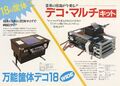 Data East advertisement for the DECO 18 WIDE universal cabinet and DECO Multi Kit, 1982
-
 DS-1T3 cocktail cabinet
-
 Early DECO Cassette System PCB rack and power supply
-
 Cassette deck assembly
-
 DS-1U2 upright cabinet
-
 DS-1U2 PCB rack
-
 DS-1U2 cassette deck
-
 Later DN-1US5 DECO hardware
-
 DN-1US5 cassette deck
-
 Later RMS8 / DSP8 / B108 system architecture


