Rock II Playtime
| Rock II Playtime | |
|---|---|
 | |
| AKA | Rock II; Rock 2; Rock Playtime; Blue Storm; Excellent Game; Excellent; Arc-Ade Stormy; WW-QF023 |
| Type | Sitdown |
| Released | 199X |
| Dimensions | 860 x 600 x 1403 mm |
| Wiring | JAMMA |
| Monitor | 25 in |
| Rotatable | Yes |
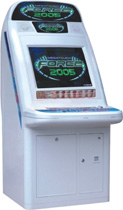
The Rock II Playtime is a Chinese-produced sitdown arcade cabinet associated with Guangzhou Qingfeng Electronics Co., Ltd.. It was sold or rebadged under a considerable number of names, including Rock II, Rock 2, Rock Playtime, Blue Storm, Excellent Game, Excellent and Arc-Ade Stormy.
Qingfeng documentation associates the cabinet design with model number WW-QF023.
The cabinet is a compact JAMMA candy-style cabinet fitted with a 25-inch CRT monitor. Its monitor can be installed horizontally or vertically, although no dedicated rotation mechanism is provided.
Manufacturer
The Rock II Playtime is associated with Guangzhou Qingfeng Electronics Co., Ltd., a Chinese manufacturer of arcade cabinets and amusement equipment.
Qingfeng used model numbers beginning with the prefix WW-QF for a number of its cabinets. The Rock II Playtime is identified as WW-QF023, providing a stronger manufacturer attribution than is available for many otherwise poorly documented Chinese candy cabinets of the period.
The same basic cabinet appears to have been exported and sold under several different names. These names may represent distributor branding, regional names or rebadged versions rather than distinct cabinet designs.
It is therefore preferable to regard WW-QF023 as the underlying Qingfeng model identification, with Rock II Playtime and the other known names representing branding applied to surviving examples.
Names and variants
A number of names have been associated with this cabinet design, including:
- Rock II Playtime
- Rock II
- Rock 2
- Rock Playtime
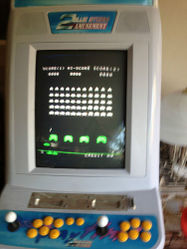
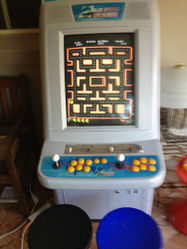
- Blue Storm
- Excellent Game
- Excellent
- Arc-Ade Stormy
- WW-QF023 — Qingfeng model number
Differences in artwork, marquee branding and colour scheme are known between surviving examples.
The relationship between the different branded versions has not been fully documented. It is possible that some were supplied directly by Qingfeng while others were rebadged by importers or amusement-equipment distributors.
The Blue Storm name used for this cabinet should also not automatically be confused with other Chinese cabinets carrying similar names. In particular, a separate cabinet called Blue Storm 2 is known from another Chinese export catalogue and should be treated as a distinct model unless evidence demonstrates otherwise.
Monitor
The cabinet is documented with a 25-inch CRT monitor.
The monitor can be fitted in either horizontal or vertical orientation, allowing the cabinet to accommodate both landscape and vertically orientated arcade games.
There is no dedicated monitor rotation mechanism, so changing orientation requires the CRT assembly to be repositioned manually.
The original monitor model and supported horizontal scan frequencies have not yet been conclusively established.
Design
The Rock II Playtime follows the general design language of Japanese candy cabinets while using a relatively narrow and upright cabinet shell.
It measures approximately 600 mm wide, 860 mm deep and 1403 mm high.
The cabinet uses standard JAMMA wiring and was therefore suitable for a wide range of contemporary arcade PCBs.
Like many Chinese cabinets of the period, the design was exported under multiple names and artwork schemes. This can make identification difficult when the original Qingfeng model label is absent.
The cabinet is classified as a clone or derivative cabinet due to its imitation of contemporary Japanese sitdown arcade cabinet design.
Identification
Useful identifiers include:
- Qingfeng model number WW-QF023
- 25-inch CRT monitor
- Approximately 600 mm wide
- Rotatable CRT mounting
- Standard JAMMA wiring
- Multiple known marquee and branding variants
Surviving cabinets may therefore look superficially different while sharing the same underlying cabinet shell.
Gallery
- Cabinet Photos
-
 Rock II Playtime
-
 Blue Storm branded example
-
 Blue Storm branded example
-
 Rock II example
-
 Rock II example


