Namco Grigio
| Namco Grigio | |
|---|---|
 | |
| Katakana | グリージョ |
| Rōmaji | GURĪJO |
| AKA | Grigio Cabinet |
| Type | Sitdown |
| Released | 2018 |
| Dimensions | 800 x 820 x 1270 (cabinet); 1750 (with upper display) mm |
| Wiring | JVS |
| Monitor | 32 in 31 kHz 1920×1080 LCD monitor |
| Rotatable | No |
| Weight | 100–105 kg |
| Power Supply | AC100V |
| Power | 49 (excluding game system) W |
The Namco Grigio (グリージョ) is a 32-inch Japanese sit-down universal arcade cabinet manufactured by Bandai Namco Amusement.
Introduced in 2018, the Grigio represents a later generation of Namco's widescreen LCD universal cabinet line and follows the earlier Namco Noir family.
The cabinet uses a 32-inch Full HD LCD, JVS wiring and interchangeable arcade game hardware. It was designed for modern high-definition arcade systems rather than being dedicated permanently to a single title.
Surviving examples are particularly associated with the Mobile Suit Gundam Extreme Vs. series, but the cabinet itself is a general-purpose platform and can be used with other compatible JVS hardware.
Design
The Grigio retains the broad layout established by the Namco Noir, with:
- Large 32-inch widescreen display
- Seated playing position
- Removable control panel
- Front service access
- Integrated speakers
- JVS wiring
- Internal mounting space for interchangeable game hardware
However, the cabinet was redesigned to be substantially lighter than the Noir.
The Grigio weighs approximately 100–105 kg, compared with approximately 130–140 kg for different Noir configurations.
The cabinet body measures approximately:
- Width: 820 mm
- Depth: 800 mm
- Height: 1,270 mm without the upper display assembly
- Height: approximately 1,750 mm with the upper display assembly fitted
These figures are documented in surviving commercial cabinet specifications.[1]
Display
The Grigio uses a 32-inch 16:9 Full HD LCD with a native resolution of:
1920 × 1080
Commercial documentation describes the display as supporting both DVI and VGA video input.[2]
The monitor is fixed in horizontal orientation and is not designed to rotate.
The precise LCD panel manufacturer and model may vary between production examples and has not yet been conclusively documented.
The Grigio is regarded as a low-latency Full HD cabinet suitable for modern arcade hardware. Later community documentation specifically lists the Grigio among Namco cabinets recommended for Full HD, sub-frame-delay arcade systems.[3]
Controls
The Grigio uses a removable control panel.
Surviving cabinets have been documented with conventional joystick-and-button layouts as well as additional input devices depending on the installed game.
A stock gamepad has also been supplied with some installations, secured to the cabinet with an anti-theft cable.
The cabinet's control area includes provision for modern game-specific accessories without abandoning the conventional universal control-panel format.
Gamepad support
Some Grigio installations were supplied with a dedicated gamepad mounted or tethered to the cabinet.
This appears to have been intended for games supporting alternate control methods rather than being an integral part of every Grigio cabinet.
Surviving promotional material shows the controller connected to the cabinet and secured with an anti-theft cable.
The exact controller model and supported protocol depend on the installed game system.
Headphone output
The Grigio includes a front-accessible headphone jack.
This allows players to use personal headphones where supported by the installed game hardware.
The presence of the headphone output reflects the cabinet's design for newer networked and competitive arcade titles.
Wiring
The Grigio uses the JVS standard.
This allows it to operate with modern Namco arcade systems and other compatible hardware.
Community compatibility testing also documents the Grigio as usable with modern universal arcade platforms without requiring additional JVS conversion hardware.[4]
The exact JVS I/O board fitted may vary depending on game installation and production revision.
Power
The cabinet operates from:
- AC100V
- 50/60Hz
The cabinet itself is documented with a power consumption of approximately:
49 W excluding the installed game system
This figure refers to the cabinet hardware and display rather than the complete installation with game PC or PCB fitted.[5]
Relationship to Namco Noir
The Grigio is closely related in concept to the Namco Noir and is generally regarded as its successor.
Both cabinets share:
- 32-inch widescreen LCD format
- JVS wiring
- Two-player universal sit-down layout
- Interchangeable game hardware
- Fixed horizontal display
- Similar 820 mm cabinet width
The Grigio differs through a newer, lighter cabinet structure and lower power requirements.
Commercial descriptions specifically position the Grigio as the successor to the Noir.[6]
Relationship to Namco Blanc
The Namco Blanc represents another branch of Namco's 32-inch widescreen cabinet family.
While the Blanc is much more closely derived from the Noir cabinet body, the Grigio is a later redesign rather than simply a colour or bodywork variation.
All three belong to Namco's modern universal LCD cabinet lineage:
- Namco Noir
- Namco Blanc
- Namco Grigio
Use with Gundam games
The Grigio is strongly associated with later games in Namco's Mobile Suit Gundam Extreme Vs. series.
Surviving cabinets have been documented running titles including:
- Mobile Suit Gundam Extreme Vs. 2
- Mobile Suit Gundam Extreme Vs. 2 XBoost
The cabinet should not, however, be regarded as a dedicated Gundam machine. Its JVS architecture and interchangeable hardware make it a general-purpose arcade cabinet.
Identification
Useful identifying characteristics include:
- Grigio / グリージョ branding
- Bandai Namco manufacture
- Grey cabinet finish
- 32-inch Full HD LCD
- 1920 × 1080 resolution
- JVS wiring
- Fixed horizontal monitor
- 820 × 800 mm footprint
- Approximately 1,270 mm cabinet height
- Approximately 1,750 mm height with upper display fitted
- Approximately 100–105 kg weight
- AC100V operation
- Approximately 49 W cabinet power consumption excluding game hardware
- Front headphone jack
- Provision for additional game-specific controllers
Gallery
-
 Mobile Suit Gundam Extreme Vs. 2 XBoost
-
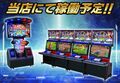 Grigio cabinets running Mobile Suit Gundam Extreme Vs. 2
-
 Promotional material showing various ports and stock gamepad
-
 Grigio cabinets at Namco Sugamo
-
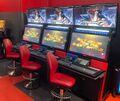 Grigio cabinets at Namco Sugamo
-
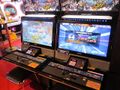 Grigio cabinet in Japan
-
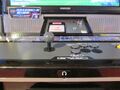 Headphone jack
-
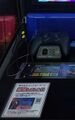 Stock gamepad
-
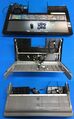 Control panel
-
 Stock gamepad and anti-theft cable
-
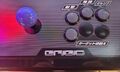 Centre control-panel detail
-
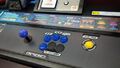 Control-panel detail


