Sega Single Kids Cab
| Sega Single Kids Cab | |
|---|---|
 | |
| AKA | Sega single-player kids cabinet; Sega single kids cabinet |
| Type | Child-size upright / card / medal |
| Released | 2003 |
| Dimensions | 600–730 x 450–719 x 1280–1480 mm |
| Wiring | Game-specific |
| Monitor | 14 in 15 kHz |
| Rotatable | No |
| Weight | 62–88 kg |
| Power Supply | Region / game-specific |
| Power | 65–103 W |
The Sega Single Kids Cab is a compact single-player children's arcade cabinet platform used by Sega for a range of card and medal games from the early 2000s into the 2010s.
Sega Single Kids Cab is a descriptive name used here for the shared cabinet design. No confirmed Sega public model designation for the bare cabinet shell has yet been identified.
The same underlying cabinet body was used for:
- Mushiking
- Dinosaur King
- Love and Berry
- Kids Yataimura Single Kingyo Sukui
- Kids Yataimura Single Shateki
- Hako Emaki Single Manpuku Suizokukan
Although these machines can look substantially different, their principal cabinet body and construction are effectively the same.
Sega adapted the platform by changing the artwork, control panel, bezel, upper signage, internal game hardware and card, prize or medal mechanisms for each title.
Overview
The cabinet first appears in Sega's early-2000s children's card-game range.
The basic design is a narrow, child-height upright intended for a single player. It places the monitor, controls and card or medal hardware substantially lower than a conventional adult arcade cabinet.
Typical features include:
- Compact single-player upright body
- 14-inch CRT display on early card-game versions
- Large removable or game-specific upper POP / marquee
- Interchangeable game-specific control-panel area
- Front speaker grille
- Lower service and cashbox section
- Game-specific card, medal or payout hardware
- Front access for operator servicing
The shared construction allowed Sega to reuse the same fundamental cabinet architecture across games with very different control and dispensing requirements.
Cabinet family
The following machines are currently known to use the same underlying cabinet design:
| Game | Year | Type | Published dimensions | Weight | Notes |
|---|---|---|---|---|---|
| Mushiking | 2003 | Card game | 452 × 610 × 1280 mm | 75 kg | Original early card-game configuration; Sega NAOMI hardware |
| Love and Berry | 2004 | Card game | 719 × 730 × 1285 mm installation dimensions | 88 kg | Game-specific wider external fittings; Sega SystemSP |
| Dinosaur King | 2005 | Card game | 450 × 610 × 1290 mm | 70 kg | Sega SystemSP; barcode cards and card dispenser |
| Kids Yataimura Single Kingyo Sukui | 2010 | Kids medal | 450 × 600 × 1480 mm | 62 kg | Single-player adaptation of the four-player medal game |
| Kids Yataimura Single Shateki | 2010 | Kids medal | 450 × 600 × 1480 mm | 62 kg | Single-player shooting-gallery medal configuration |
| Hako Emaki Single Manpuku Suizokukan | 2013 | Kids medal | Unknown | Unknown | Single-player adaptation of the larger Hako Emaki medal game |
The published measurements above refer to the complete game-specific machines rather than necessarily to the dimensions of the bare shared cabinet shell.
Differences in upper signage, side structures, control assemblies, medal hardware and other external fittings can therefore produce significantly different published installation dimensions even where the main cabinet body is the same.
Shared cabinet design
The principal cabinet body is a compact upright constructed around a common Sega children's arcade layout.
Across the known examples, the main shell retains:
- Similar overall side profile
- Common monitor position
- Common front speaker area
- Common lower access-door arrangement
- Similar rear cabinet structure
- Adaptable control-panel mounting area
- Adaptable upper signage / POP mounting
The most significant visual differences are produced by game-specific parts fitted to this common body.
These include:
- Control panels
- Bezels
- Marquees and POP displays
- Side and front artwork
- Card readers
- Card dispensers
- Medal acceptors
- Medal payout hardware
- Buttons, dials and other controls
- Internal game boards and power hardware
This modular approach allowed Sega to adapt the same compact cabinet to card games, rhythm / fashion games and later children's medal titles.
Technical variation
The shared cabinet shell should not be confused with a single fixed hardware specification.
Internal electronics vary significantly between games.
Mushiking
The original Mushiking configuration uses Sega NAOMI hardware.
Its factory specifications include:
- Width: 452 mm
- Depth: 610 mm
- Height: 1280 mm
- Height with POP: 1590 mm
- Weight: 75 kg
- Monitor: 14-inch colour CRT
- Card capacity: 600
- Power consumption: 102 W at AC120 V / 60 Hz
- Power consumption: 103 W at AC220 V / 50 Hz
Love and Berry
Love and Berry uses Sega SystemSP hardware and a substantially different control-panel and card-reader arrangement.
Its English manual gives installation specifications of:
- Width: 719 mm
- Depth: 730 mm
- Height: 1285 mm
- Height with POP: 1629 mm
- Weight: 88 kg
- Monitor: 14-inch colour CRT
- Card capacity: 600
- Power consumption: 75.5 W maximum at AC120 V / 60 Hz
The unusually large published width and depth reflect the complete Love and Berry installation and game-specific fittings rather than a fundamentally different main cabinet shell.
Dinosaur King
Dinosaur King uses Sega SystemSP hardware.
Published specifications include:
- Width: 450 mm
- Depth: 610 mm
- Height: 1290 mm
- Height with POP: 1618 mm
- Weight: 70 kg
- Monitor: 14-inch CRT
- Monitor model: Sanwa 14VC21S
- Video frequency: 15 kHz
- Card capacity: 600
- Power consumption: approximately 81–89 W depending on regional specification
Kids Yataimura Single
The Kids Yataimura Single Kingyo Sukui and Kids Yataimura Single Shateki versions share the following published cabinet specifications:
- Width: 450 mm
- Depth: 600 mm
- Height: 1480 mm
- Weight: 62 kg
- Power consumption: 65 W
- Input: AC100V
These later versions adapt the cabinet for medal-game use rather than card dispensing.
Terminology
No confirmed Sega model number for the common bare cabinet shell has yet been identified.
Period documentation instead uses functional descriptions including:
- シングルキッズ筐体 — single kids cabinet
- シングルメダル筐体 — single medal cabinet
These terms appear to describe the role or configuration of the machine rather than constitute a unique formal cabinet model designation.
For this reason, Sega Single Kids Cab is used here as a practical umbrella term for the shared design.
It should not be presented as an official Sega model name unless further factory documentation establishes one.
Timeline
| Year | Cabinet / game | Development |
|---|---|---|
| 2003 | Mushiking | Earliest currently documented major use of the cabinet. Card dispenser, barcode reader and three-button control panel. |
| 2004 | Love and Berry | Cabinet adapted for fashion-card scanning and rhythm-game controls. |
| 2005 | Dinosaur King | SystemSP-based card-game configuration using dinosaur and skill cards. |
| 2010 | Kids Yataimura Single Kingyo Sukui | Cabinet adapted from children's card-game use to single-player medal operation. |
| 2010 | Kids Yataimura Single Shateki | Shooting-gallery medal-game configuration. |
| 2013 | Hako Emaki Single Manpuku Suizokukan | Later single-player medal configuration based on the larger Hako Emaki game. |
Reuse and conversion
Surviving cabinets provide evidence that Sega did not merely reuse the cabinet design in an abstract sense, but in some cases physically converted earlier machines into later configurations.
A surviving Kids Yataimura Single Shateki cabinet has areas where the later finish has worn through to reveal the orange paint associated with a Dinosaur King cabinet underneath.
Similar reuse has been reported for later Kids Yataimura Single Kingyo Sukui machines.
This provides strong evidence that at least some later medal cabinets were converted from Sega's earlier children's card machines.
It does not establish that every later cabinet was a conversion. Sega may have used a mixture of reused cabinets and newly manufactured examples of the same shell.
Monitor and video
The early card-game configurations are associated with compact 14-inch CRT monitors.
Known examples include:
- Mushiking — 14-inch colour CRT
- Love and Berry — 14-inch colour CRT
- Dinosaur King — 14-inch Sanwa 14VC21S
The physical cabinet platform was therefore designed around a small display suited to child-height operation.
Individual later medal-game configurations may use different display hardware, and monitor type should be documented per game rather than assumed from the shared shell.
Controls
The cabinet's adaptable control area is one of its defining features.
Known configurations include:
- Mushiking — three large skill buttons
- Love and Berry — game-specific rhythm / selection controls and card reader
- Dinosaur King — game-specific battle controls and barcode reader
- Kids Yataimura Single Kingyo Sukui — goldfish-scooping controls
- Kids Yataimura Single Shateki — aiming dial / control and action button
- Hako Emaki Single Manpuku Suizokukan — three large illuminated buttons
This variation demonstrates that the cabinet was effectively a reusable physical platform rather than a design tied to one particular control scheme.
Gallery
-
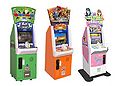 Mushiking, Dinosaur King and Love and Berry examples of the shared Sega single-player kids cabinet
-
 Hako Emaki Single Manpuku Suizokukan
-
 Kids Yataimura Single Kingyo Sukui
-
 Kids Yataimura Single Shateki


Known games
- Sega Mushiking
- Sega Love and Berry
- Sega Dinosaur King
- Sega Kids Yataimura Single Kingyo Sukui
- Sega Kids Yataimura Single Shateki
- Sega Hako Emaki Single Manpuku Suizokukan